
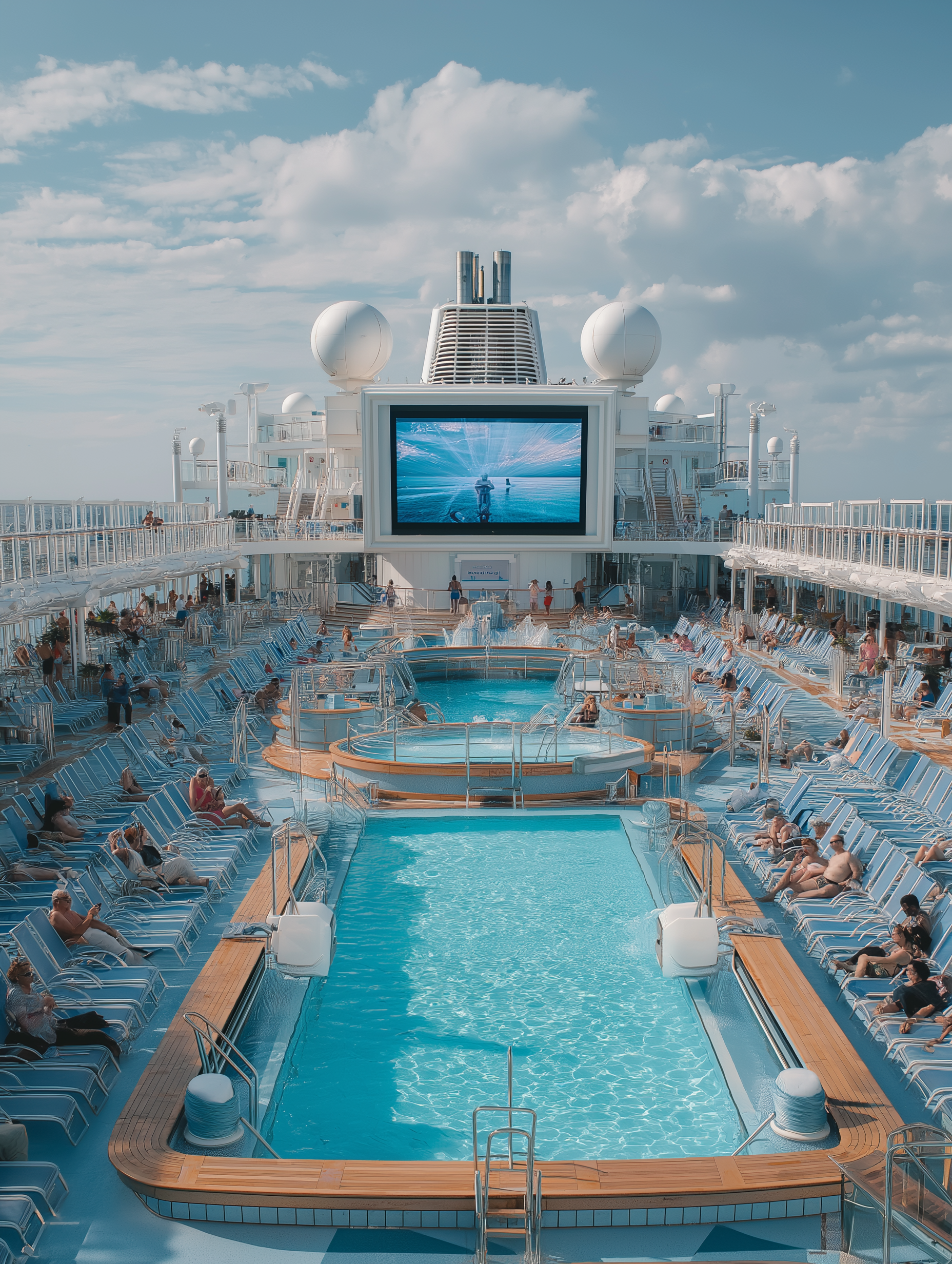
In popular culture, cruise travel is usually presented as one of the easiest and most glamorous forms of escape. Films show glowing decks at sunset, elegant dinners, flirtation under soft lights, and the endless promise of reinvention somewhere between one port and the next. Advertising goes even further. It polishes the image until a cruise no longer looks like a moving maritime system at all, but like a floating resort detached from logistics, labor, and the ordinary limits of life on land. The result is powerful and effective, but also misleading. Cruise travel is not only a spectacle of leisure. It is a highly coordinated world of engineering, hierarchy, navigation, hospitality, environmental management, and human discipline. Cinema and advertising have not invented the pleasure of cruising, but they have narrowed its image into something far simpler than reality.
The appeal of that simplified image is easy to understand. Cruise lines do not sell transportation alone. They sell anticipation, fantasy, and emotional distance from routine. Movies and commercials know this instinctively. They focus on what can be felt immediately: freedom, luxury, romance, spontaneity, and visual abundance. A ship appears as a place where ordinary rules dissolve. Time slows down, responsibilities fade, and every corridor seems to lead toward some new pleasure. This is a compelling narrative because it compresses many desires into one setting. The cruise becomes not merely a holiday, but a symbolic escape from complexity itself.
Yet that is precisely where the distortion begins. A cruise ship is, in fact, a dense concentration of complexity. It is a vessel that must function as hotel, restaurant network, entertainment venue, transportation system, safety structure, workplace, and temporary home for thousands of people at once. Nothing about it is simple. Beneath the image of effortless celebration lies an environment built on exact timing, invisible labor, technical systems, and constant operational control. The fantasy depends on this hidden framework, but rarely admits that it exists.
Film has long been drawn to ships because they create a naturally cinematic world. A ship isolates people, compresses them into a shared space, and places them against an open, shifting horizon. It is perfect for romance, mystery, comedy, class drama, and personal transformation. But when cruise ships appear in this visual tradition, they are often reduced to stages for emotion. The vessel matters less as a working system than as a backdrop for glamorous encounters or dramatic tension. Even when the sea itself becomes a force in the story, the ordinary reality of ship life is usually edited out. The audience sees the dance floor, not the maintenance schedule. It sees the champagne glass, not the chain of supply and labor that placed it there.
Advertising intensifies the same reduction, though with even less interest in ambiguity. Commercial images are designed to eliminate friction. They remove waiting, fatigue, crowding, procedural rules, and all the tiny negotiations that shape real travel. On screen, no one is lost, tired, seasick, bored, or overwhelmed. No passenger misreads the rhythm of life on board. No crew member appears exhausted. The ocean is calm, the timing is perfect, the service is immediate, and the entire ship seems to run on the natural energy of pleasure itself. This is not an outright lie, but it is a carefully curated fraction of truth. It presents the reward while erasing the system that makes the reward possible.
One of the biggest consequences of this distortion is that it changes what people expect from a cruise before they ever board a ship. Many first-time passengers arrive not with an understanding of maritime travel, but with a borrowed cinematic script. They expect constant stimulation, constant elegance, and constant emotional brightness. They imagine every hour as a highlight. But real cruises have rhythm. They involve waiting, transitions, routines, and repeated patterns. There are quiet stretches between events, practical procedures behind every convenience, and limits imposed by weather, schedules, geography, and ship design. Those who expect an uninterrupted sequence of movie-like moments may end up misunderstanding what cruise travel actually offers.
Cinema and advertising also distort the role of the crew. In visual storytelling, crew members are often background figures whose purpose is to maintain the illusion that the ship runs itself. In advertisements, they smile, serve, and vanish. In films, they may appear only when needed for atmosphere or plot. But in reality, a cruise depends on a complex hierarchy of skilled workers whose labor is constant, structured, and physically demanding. Hospitality staff, engineers, cleaners, cooks, technicians, navigational officers, entertainers, and safety personnel all sustain the experience. Their work does not merely support the holiday. It is the machinery of the holiday. By making that labor nearly invisible, popular imagery reinforces the false impression that luxury is effortless by nature rather than produced through discipline and coordination.
The sea itself is also changed by representation. In cruise advertising, the ocean is almost always a beautiful surface: blue, calm, reflective, and reassuring. In film, it may become romantic, mysterious, or dramatic, but still largely symbolic. What disappears is the ocean as environment and condition. The sea affects mood, movement, isolation, orientation, and even the perception of time. Long stretches between ports can be meditative for some passengers and unsettling for others. Northern waters create a different emotional atmosphere from tropical routes. Weather matters. Distance matters. Scale matters. But mass imagery usually turns the ocean into a decorative frame, reducing one of the most powerful parts of the cruise experience to a postcard.
There is also a broader cultural reason these distortions persist. Modern tourism is often sold through the language of frictionless pleasure. Complexity does not market as well as ease. Systems do not sell as well as fantasies. A cruise line can show the choreography of a gala dinner more easily than the logistics of fuel, staffing, waste management, navigation, safety drills, port coordination, and maintenance. The polished image is not accidental. It is central to how the product is imagined. Cruise travel becomes desirable partly because it appears to free the traveler from noticing systems at all.
And yet, for many thoughtful travelers, the hidden system is not something that diminishes the magic of cruising. It can deepen it. To understand a cruise ship as a living maritime structure rather than a floating postcard is to appreciate it more fully. The pleasure becomes more interesting when seen alongside the discipline that sustains it. The beauty of the voyage does not disappear once one notices the work behind it. On the contrary, it becomes more real.
Film and advertising have given cruise travel one of the most recognizable images in modern leisure culture: endless celebration, endless elegance, endless escape. But that image is incomplete. A cruise is not simply a festival on water. It is a moving world held together by labor, design, technology, hierarchy, and the unpredictable presence of the sea. The fantasy remains attractive, and perhaps it always will. But the true fascination of cruise travel begins when the polished picture cracks slightly, and the deeper system underneath comes into view.